
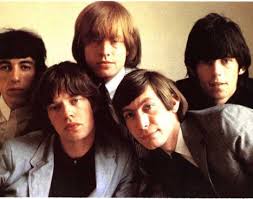
As I passed the convocation center this evening on my way to take my sister's Zumba class (which is awesome), I noticed that the marquee said "New Kids on the Block Feb. 25."
Tonight as I was making my social network rounds, I happened to catch one of my old friends' status updates. It read "MOTLEY CRUE in 5 DAYS!!!"
My question: besides the obvious pursuit of financial capital, why do bands and "groups" (since I won't qualify NKOTB as a "band") insist on dragging themselves out for world tours twenty+ years after the peak of their fame? Last year at one of the Louisiana casinos, Hall and Oats performed. Hall and freaking Oats!!! Let's get real people. Going to see these shows (or playing them) does not bring back a nugget of youthful glory. It does not mean that the music you once liked, when heard live decades after the expiration date of its shelf life, is able to provide anything but wistful nostalgia tinged with more than mild disgust at this late date in the new century. But apparently this trend is working for some people; I guess it must be, because the old folks keep rollin' out the "final final farewell" tours year after year and charging $65 a pop for folks to see their geriatric unwillingness to retire the dream. The Rolling Stones just completed a world tour in 2006. That fact alone seems an appropriate way to end this rant.

In other news, I have chosen as my "specialty" in one of my grad seminars this semester the feminist take on composition. In Collin's class, we're responsible for finding 4 articles per week from the years 1999-2009 (10 weeks, covering one year per week), logging them on a database Collin set up through wordpress, and bookmarking/tagging them through our communal delicious account. I really like the class so far and I feel like this database and tagging idea will prove invaluable when having to study for comps and such, since each week I vow to log summaries of everything I have read on my own web depository but nearly always fall short of my goal, except in Collin's class because, well, the summaries are required. (Gotta love it).
Anyway, I chose to read comp articles written from a feminist perspective because I am interested in this subfield and I need to learn more about it. I've been growing concerned, however, because I often find myself wrestling with the feasibility of the claims so many feminist writers during this time period are making. I'm not going to go into detail in regards to just the kinds of claims I find most troubling, but I will say that I've been getting frustrated by the frequency with which sweeping claims that feminist rhetoric can effectively "change the world" and finally bring about a truly democratic society appear in the articles I've been reading. I look at the world around me, at the university's current station in that world, in rhet/comp's (rising but still sublimated) position in the university, and especially at feminism's location in rhet/comp... and I shake my head to read the broad assertions that if feminists can just change 1) the way we speak 2) the way people listen and 3) the entire infrastructure of the institutions patriarchy built, we'll have it made. It's upsetting, to say the least.
But still, its not as upsetting as doing nothing. I suppose change has to be effected someway, somehow. I guess what bothers me is that so many articles act as though we are just on the brink of being able to achieve such lofty aims, while in reality, it is painfully apparent that we are not and that we have in fact been moving further away from that lauded precipice with each passing decade. I can understand and appreciate, however, that without this hopeful, humanistic narrative, rhetors in today's academy would have no ground on which to stand whilst defending their intellectual activities against those who challenge them. Since the social turn, we don't have a leg to stand on if we poo-poo the idea that a participatory democracy is achievable and that we are the ones who can make it happen, if only given the chance. To eschew that belief is to give up one's card-carrying privileges (and I do mean privileges) in the ranks of the field - still, it too frequently feels to me like these articles pay only so much lip service to this idyllic dynamic, mostly because it is fundamentally unattainable within the constructs of late capitalism.
Through this veil of disparaging cynicism, though, I have found some hope (which is good, because maybe I can harness it and quit earning scowls from my classmates by whining about how iffy I am towards the democratic ideal). John and I are working through some communication books in order to improve the way we - you guessed it - communicate with each other. It might sound hokey, but it feels good to learn new strategies for getting along together, and it gives us interesting and often surprising perspectives on one another's inner-workings. At any rate, we were running one of the exercises the other night, which required us to select and work through a relatively small but persistent issue. During this exercise, I found myself trying to convince John of my point of view... and then I stopped.
Having just read Ryan and Natalle's extension of Foss, Foss, and Griffin's Invitational Rhetoric, I recalled the tenets of that paradigm and the additions Ryan and Natalle had made to the theory in order to work out some of its more problematic kinks and position it more solidly within rhetorical theory. I thought about standpoint hermeneutics and what all of these women believed an invitational rhetorical approach could accomplish.
And I used it. I quit trying to use my communicative abilities to persuade; I just let go of my desire to control the situation and to influence my "audience" to accept my position. Instead, I just said how I felt about things. Then I freed myself from the desire to effect change and realized that change might happen, if the other was so inclined to effect it. I have to say that for all the skepticism and annoyance I sometimes experience when reading feminist writing, this tactic felt great and I actually saw it in action - and working. I have always been a very controlling and bossy person, the kind of kid who hated to get into groups for class projects because I was sure none of the other kids were going to want to do things the way I wanted (which, clearly, was the best way). Through my still modest study of feminist rhetorical theory and feminist rhetoric, I can recognize my way of belief as the product of a society which values, above all, "the individual;" a society which was constructed and is governed by phallocentric impetus and patriarchal ideology. Letting go of my incessant necessity to bring the other to my way of thinking - and realizing that I am letting go - is incredibly liberating.
Hence the final element of my title. Perhaps there is hope for my high-strung, authority-abiding, rule-bound personality after all... and perhaps it will be found in the subversive and disruptive strategies of feminist tactic. Perhaps changing the world is not a goal that I can see as attainable - but changing my world is certainly one that is, and for now, the promise of building a better, wider world for myself, my family, and my students is a good enough prospect for me to continue pushing my comfort zone and challenging my pessimistic cynicism.


Hey Melissa Kizina,
ReplyDeleteFirst time messager, long time fan.
I just wanted to suggest a Linguistics book that might tie into your readings about Feminist Rhetors wanting to change the way people talk. It's called Verbal Hygiene and it's written by Deborah Cameron. I've only read the first chapter, but its worth checking out (at least that much). If ur interested, I can email you a scanned copy that I made for my students. She basically argues, from a very linguisticky place, that the process of cleaning up our speech is an important and inherent part of human language. By "our speech" I/she mean/s "others' speech" and by "cleaning [it] up" I mean "prescribing norms and trying to enforce those norms."
--From: I Bet U Know Who!
email me if ur interested. spj2922@yahoo.com
Hello Melissa,
ReplyDeleteOn the "old hat" band tours issue (I'm interested in this as well): I think you might attribute the rise of washed up bands to a crisis of identity that currently plagues the mainstream music industry. Without sounding too Deleuzean, the rhizomatic structure is overtaking top-down, arboreal organization for music labels. As tastes fragment and further fragment away from the "mainstream" through social media, bittorrenting, etc., the music industry has been left with a void. No more supergroups. No more U2, no more worldwide, 36-stop tours. . . and, hopefully, no more manufactured taste. While I don't think we've come quite that far, the splintering of musical taste is exactly why you see recycled supergroups still touring - the music biz doesn't know what else to throw out there. Unfortunately, I suppose the big labels marketing strategy of remobilizing the grizzled tour vets is somewhat insidious as you also see these same folks echoed in cable reality television (a la Bus of Rock of Love of Decadence season 35). Anyways, that's my two cents! Thanks for a great read and a great blog!
justin l.